
If you’re preparing for NEET 2026, you’ve probably wondered, “Is the living world in the NEET syllabus 2026?” The answer is yes—but with important changes. The chapter is still very much part of your preparation, though certain topics have been removed to streamline your study load.
The Living World, officially called “Diversity in the Living World” in NEET terminology, is the gateway chapter of class 11 biology. It introduces the fundamental concepts of what makes something “living”, how organisms are classified, and the amazing diversity of life on Earth.
Here’s what you need to know: About 90 questions come from biology in NEET (out of 180 total), and The Living World typically gets 1-2 questions. That might sound small, but it’s your foundation. Miss the basics here, and later chapters become harder to understand.
Let’s break down exactly what’s included, what’s deleted, and how to master this chapter for NEET 2026.
What Exactly Is The Living World Chapter About?
The Living World chapter covers the characteristics that separate living organisms from non-living things. It’s not as complicated as it sounds.
Think about it this way: What makes a dog alive and a rock not alive? The answer lies in seven key characteristics. Every living organism shows these traits: they respire, grow, reproduce, respond to stimuli, maintain homeostasis, and evolve.
Beyond that, the chapter introduces taxonomy—the science of classifying organisms. You’ll learn about binomial nomenclature (the Latin naming system), taxonomic ranks (species, genus, family, class, etc.), and the concept of biological diversity.
The chapter builds your foundation for understanding all the complex topics that follow in Class 11 biology, like cell structure, plant physiology, and human physiology.
Is Living World in the NEET syllabus 2026? Official Status
Yes, the Living World is 100% in the NEET 2026 syllabus. The National Medical Commission (NMC) and National Testing Agency (NTA) officially released the syllabus on January 8, 2026, and this chapter remains a core part of the biology section under “Diversity in the Living World”.
The NEET Biology 2026 syllabus includes The Living World with roughly the same structure as previous years, though certain specific topics have been removed to align with revised NCERT textbooks.
What Topics Are Removed from The Living World for NEET 2026?
This is crucial—knowing what NOT to study saves you months of wasted effort.
Topics Deleted from The Living World:
- Taxonomical aids – Keys, monographs, flora, and catalogues are completely removed
- Museum and herbaria details – Specific examples of how museums preserve specimens are no longer tested
- Zoological parks classification methods – Details about the zoo organization and display are removed
- Catalogues and botanical gardens – While you may read about them, they won’t appear in NEET questions
- Three domains of life – This concept has been streamlined; focus on the basic classification system instead
The good news? These deletions are mostly the descriptive, less conceptual topics. The core of what makes The Living World important—living characteristics, taxonomy, and binomial nomenclature—remains fully intact.
What topics are still included in the living world?
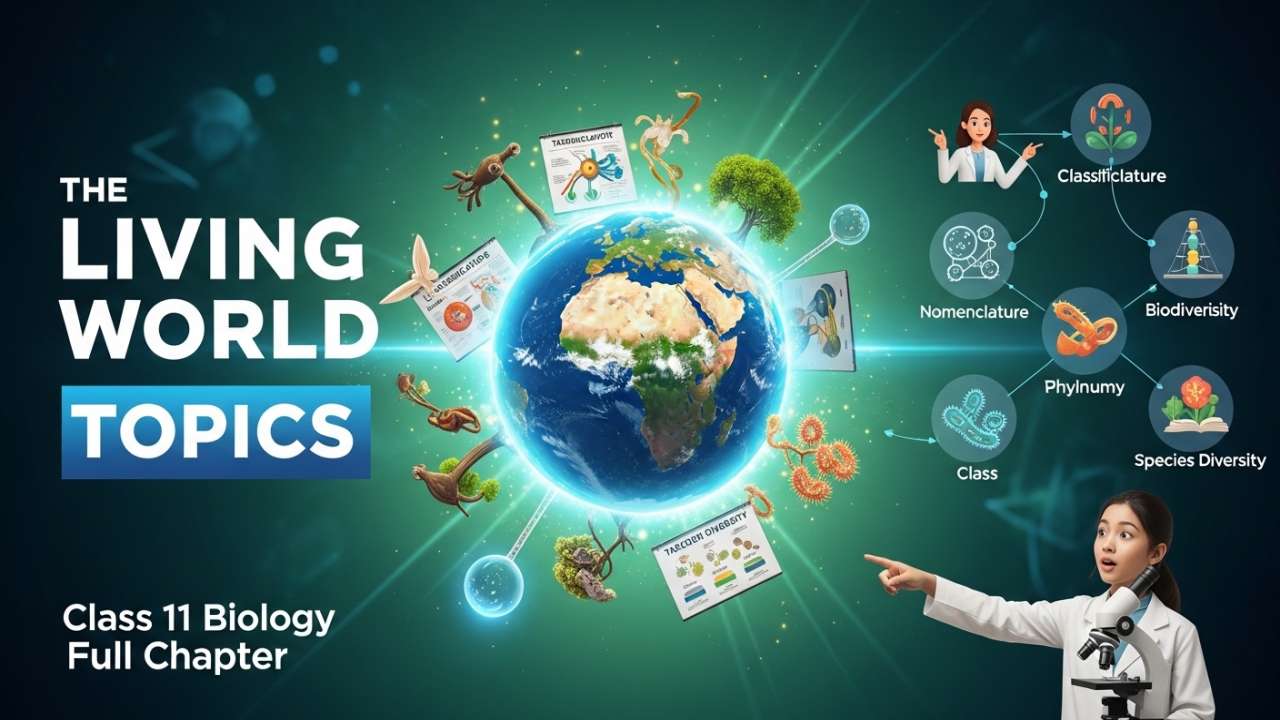
Here’s what you absolutely must master for NEET 2026:
Must-Know Topics:
- What is living? – The seven characteristics of life (metabolism, growth, reproduction, responsiveness, homeostasis, adaptation, evolution)
- Biodiversity – The variety of life forms and why classification is needed
- Concept of species – What defines a species using the biological species concept
- Taxonomic hierarchy – Kingdom → Phylum → Class → Order → Family → Genus → Species (KPCOFGS)
- Binomial nomenclature – The Latinized naming system with genus and species (example: Homo sapiens)
- Taxonomy and systematics – How organisms are grouped and the principles behind classification
These topics appear in almost every NEET paper. Learning them thoroughly isn’t optional—it’s your ticket to easy marks in the Living World section.
Also Read:- NEET Biology Mock Test – Plant Kingdom Test 1 | Free Online Exam Practice
How Many Questions Come from the Living World in NEET?
Typically, the Living World accounts for 1-2 questions in the NEET paper. That means 4-8 marks out of 360 total marks.
While that seems small, here’s why it matters:
- These marks are easy – The Living World questions are straightforward and don’t require complex calculations
- Foundation for other chapters – If you skip this, you’ll struggle with botany and zoology later
- High accuracy rate – Most students who understand the basics score full marks on Living World questions
- Quick revision – You can revise The Living World in 2-3 hours before the exam
Common NEET Questions from The Living World
Understanding the question pattern helps you prepare smarter. Here are the types of questions that typically appear:
Type 1: Identifying living characteristics. Example: “Which of the following is not a characteristic of life?”
- Growth, reproduction, metabolism, or organization are tested
Type 2: Binomial nomenclature and naming Example: “The scientific name of tiger is _____”
- You need to know Panthera leo (lion), Panthera tigris (tiger), Homo sapiens (human), etc.
Type 3: Taxonomic hierarchy and ranking. Example: “Arrange these ranks in order from smallest to largest: Class, Species, Genus, Kingdom.”
- The order of the answer is crucial
Type 4: Concept of species Example: “Two organisms can reproduce together and produce fertile offspring. They belong to the same _____”
- Answer: Species
Type 5: Definition and classification. Example: “Why do organisms need classification?”
- To organize diversity, understand relationships, and study organisms systematically
What Topics Are Removed But Might Still Appear Indirectly?
Here’s a practical tip: Some deleted topics might appear as secondary information in questions about other chapters.
For example, even though “zoological parks” details are removed, a question might mention “animals from a zoo” while testing something else entirely.
The strategy? Study the deleted topics at a surface level so you’re not completely blindsided, but don’t spend weeks memorising details about museum preservation techniques.
How to Download NEET 2026 Syllabus PDF
If you want the official document, here’s how to get it:
- Visit neet.nta.nic.in (official NTA website)
- Look for the “NEET UG 2026 Syllabus” notification
- Download the Biology PDF directly
- Check the date to ensure it’s the 2026 version (avoid outdated 2025 files)
The official PDF is free and should be your primary reference. It lists every chapter and topic systematically.
Expert Tips for Mastering The Living World
Tip 1: Learn the taxonomic hierarchy with a memory tool Use KPCOFGS: Kingdom, Phylum, Class, Order, Family, Genus, Species. Create a sentence to remember it (any sentence works!).
Tip 2: Focus on examples Don’t just memorize “binomial nomenclature.” Learn 8-10 organism names:
- Tiger: Panthera tigris
- Lion: Panthera leo
- Human: Homo sapiens
- Dog: Canis familiaris
- Mango: Mangifera indica
- Wheat: Triticum aestivum
Tip 3: Understand the “why,” not just the “what” Instead of memorizing “living things have metabolism,” understand why: All organisms need energy, and metabolism is how they get it.
Tip 4: Make comparison tables Create a quick table comparing characteristics of different organism types. Visual learning sticks in your memory longer.
Tip 5: Practice previous year questions NEET repeats question patterns. Solve papers from 2016-2025 to understand what examiners value.
Also Read:- Free Physics Mock Test – Chapter-wise Test Series -Test 1
How to Study The Living World Effectively
Week 1: Basics and Characteristics
- Learn the seven characteristics of living organisms
- Understand why classification is necessary
- Create visual notes on living vs. non-living
Week 2: Taxonomy and Binomial Nomenclature
- Master the taxonomic hierarchy (KPCOFGS)
- Learn binomial nomenclature rules
- Memorize 10-15 organism names with their scientific names
Week 3: Concept of Species and Classification
- Understand the biological species concept
- Learn why some organisms are difficult to classify
- Practice identifying organisms based on descriptions
Week 4: Revision and Practice
- Solve 40-50 MCQ questions from The Living World
- Revise memory tools and important names
- Take mock tests to check your understanding
Important Link
| Download Syllabus | Click Here |
| Official Notice | Click Here |
Frequently Asked Questions About Living World in NEET 2026
Q1: Is the Living World chapter removed from NEET 2026? A: No, it’s still part of the syllabus. Only specific topics within the chapter have been deleted.
Q2: How many marks does The Living World typically carry in NEET? A: Usually 4-8 marks (1-2 questions out of 90 Biology questions total).
Q3: What’s the difference between taxonomy and classification? A: Classification is the process of grouping organisms. Taxonomy is the science that studies this grouping and naming system.
Q4: Do I need to memorise all organism names for NEET? A: You don’t need to memorise every organism, but learning 8-10 common examples (tiger, lion, human, mango, etc.) is essential.
Q5: Will NEET 2026 test deleted topics? A: No, officially deleted topics won’t be directly tested. However, related conceptual questions may still appear.
Q6: Is NCERT enough for The Living World chapter? A: Yes. Class 11 NCERT Biology Chapter 1 covers The Living World completely. Most NEET questions come directly from NCERT content.
Q7: What’s the weightage of The Living World compared to other Biology chapters? A: It’s relatively low (1-2 questions). Chapters like Human Physiology (18-20 marks) and Genetics (15-18 marks) carry more weight, but every mark counts.
Q8: How should I approach binomial nomenclature questions? A: Remember: First word is genus (capitalized), second is species (lowercase), both in italics. Example: Panthera tigris
Conclusion
Yes, The Living World is absolutely in the NEET 2026 syllabus, and it’s an excellent chapter to master for quick, reliable marks. The chapter tests your understanding of fundamental biological concepts, and with focused preparation, you can easily score full marks.
Remember: This chapter builds your foundation for all of Biology. The characteristics of life, taxonomy, and binomial nomenclature appear indirectly in questions about cells, genetics, evolution, and ecology. Strong basics here = stronger performance overall.
Focus on what’s tested (living characteristics, taxonomy, species concept, binomial nomenclature), skip what’s deleted (taxonomical aids, museum details), and practice with previous year papers.
Start your preparation today, and you’ll have this chapter mastered in 3-4 weeks. That’s time you can then invest in the heavier chapters like Human Physiology and Genetics.
Your NEET success begins with understanding what living really means. Make The Living World chapter your strength, not your weakness.
Disclaimer
This article is based on the official NEET 2026 syllabus released by the National Medical Commission (NMC) on January 8, 2026. While we’ve made every effort to provide accurate information, syllabus changes are always possible. We recommend regularly checking the official NTA website (neet.nta.nic.in) for the latest updates. Always refer to your official NCERT textbooks as the primary study material.